The Architecture of Trust: How the 3 Ps and 4 Rs Define Exceptional Leadership
Across distinct worlds—the high-stakes fireground, natural disaster response, and the corporate boardroom—I have observed a fundamental truth: title alone never makes a leader. Early in my career, whether pulling hose through smoke-filled corridors, performing complicated rescues, conducting tactical training, or navigating complex business transformations, I learned that positional authority only grants you temporary compliance. It never grants you true commitment. Real leadership is built on trust, and trust is an operational architecture you must deliberately construct.
Whether you are commanding an engine company, a search & rescue task force, managing a corporate department, running an enterprise project, or guiding a training program, your ability to influence comes down to two foundational frameworks: The 4 Rs and The 3 Ps.
Identify What is Really Important
In every leadership seminar and training class I conduct, I open by asking a foundational question. I write a list on the board and ask the participants to examine what truly matters to them (just to name a few):
- Money & Status
- Title or Position
- Schedule & Flexibility
- Benefits & Longevity
- Relationships & Family
- Health & Peace of Mind
- Respect & Admiration
Then I ask the room: “Which of these matter to you? And does being ‘successful’ automatically secure them?”
Your answer defines your version of success. But regardless of your target, one truth remains: Success is not an accident; it is a probability game.
You increase your odds of success through intentional investment. In financial markets, if you invest nothing, you yield nothing; if you invest little, your return is little. The exact same law of probability applies in high-stakes environments like firefighting. When conducting a primary search for trapped occupants in a burning building, we don’t search randomly. We target high-probability areas first—doorways, windows, and primary egress paths. We invest our initial time where the probability of finding someone is highest.
Increasing the Odds of Success
To dramatically increase your probability of success as a leader, you must execute these high-probability behaviors long before you ever carry a title:
- Do the job first: Prove your capability in action before expecting recognition.
- Do the job to get the job: Perform at the next level today.
- Make yourself irreplaceable: Master your craft through extraordinary attention to detail.
- Leave it better than you found it: Improve every process, facility, team, or station you touch.
- Be in the present: Focus fully on the task and people right in front of you.
- Be considerate: Anticipate the needs of your team and peers.
- Don't wait for someone else to do it: Take immediate initiative.
Real leadership is built on trust, and trust is an operational architecture you must deliberately construct.
The Core Engine: The 4 Rs and the Ultimate "T"
Trust is not a vague feeling or a lucky coincidence; it is an output generated by a clear, predictable formula:
RELATIONSHIPS ➜ RESPECT ➜ RESPONSE ➜ RESULTS ➜ (TRUST)
Relationships warrant Respect, Respect creates a positive Response, a positive Response delivers Results, and all of this ultimately develops Trust.
-
Relationships Leadership begins with establishing good, solid relationships. Getting to know people on a personal level fosters a genuine sense of caring and mutual consideration. When you take time to understand your team members as individuals, you build the bedrock of operational unit cohesion. Solid relationships warrant a deep level of respect because you now actually care about the individual.
-
Respect When authentic relationships exist, mutual respect and admiration naturally follow. You personally know each other and care about each other's success. You hold high regard for who your teammates are and what they do, finding real worth in their words and actions. Mutual respect creates a positive response.
-
Response A positive response promotes deep consideration and understanding. Team members who respect each other will not put one another in a bad position. They actively do the little things to make each other look good. The dynamic becomes entirely supportive instead of critical. In this environment, we find genuine joy in each other's success and sorrow in each other's failure. A positive response delivers results.<
-
Results High-Response teams are High-Performance teams, and they consistently bring solutions for the betterment of the organization. They accomplish difficult tasks, meet critical deadlines, and stay productive and profitable. They help teams win, organizations grow, and individuals advance in their careers. Delivering these results ultimately develops deep, unshakeable Trust in the relationships you established to begin with.
The Operational Blueprint—The 3 Ps: People, Process, Product
Once trust is established, a leader must focus on the operational structure. A great PRODUCT is delivered with the right PROCESS, executed by PEOPLE who are happy and valued.
-
People (Priority #1) People must always be an organization's number one priority. This includes your employees, co-workers, customers, clients, and organizational partners. Taking care of people first means providing fair salary and benefits, proper tools and equipment, and a safe, supportive working environment. But it goes deeper than compensation: people are happy not just because they get paid well, but because they feel appreciated, valued, and possess a clear sense of purpose and belonging. When everyone feels "we are all in this together as a team," happy people optimize the use of the right process.
-
Process An effective process must be efficient, rewarding, transparent, and purposeful. It should instill a sense of accomplishment while leaving room for innovation and creative problem-solving. A great process builds inclusion and belonging; it is flexible enough to adapt to real-world friction, yet robotic when precise standard operating procedures are required. When the process fits the team's objectives and makes total sense to the individuals executing it, the right process delivers a great product.
-
Product The end result must be a product or service that cannot be denied. It should be successful, profitable, sustainable, reproducible, and so exceptional that it cannot be ignored. A great product is one that all stakeholders—from the front-line worker to executive leadership—would want to use themselves. In the fire service and public sector, your product is the high-level service you provide to the community in their most critical moments of need.
The Mechanics of Effective Leadership
Delivering an undeniable product requires four fundamental principles: Leadership, Follow-Through, Consistency, and Humility.
-
Leadership & Problem-Solving What determines leadership? Is it your position or title? Who is the actual leader—you or your supervisor? Leadership is often indirect. You can lead from the front or lead from the back (there is a time and place for each) by empowering others, mentoring, and leading by example. A true leader must always be willing and able to do what they ask or expect others to do.
When a crisis or obstacle occurs, what is the first thing that comes to mind? Is it "a problem" or "MY problem"? Do we look for solutions or look to assign blame? In effective leadership, everything is MY problem. Because we operate as a team and prioritize people, his or her problem is my problem too. Their win is my win, and their loss is my loss. We succeed together, and we fail together.
Position is merely a role you play; leadership is determined by your daily actions.
In my experience across emergency response and business, anyone can rise to a higher rank or an executive position because they test well and/or have the right credentials, certifications, or degrees. However, there are two types of individuals:
- Those with an inherent belief in themselves and what they do: They walk with quiet confidence. Success is expected rather than a shock, so it is met with modesty, humility, and sincerity.
- Those whose self-belief depends entirely on external achievements: They walk with caution and lingering doubt. Success is a constant surprise, every small win is loudly celebrated, and they continuously seek external recognition and validation.
But only one of these individuals rises to be a true leader! Which one are you?
It is always about "POISE" over "POSE." We cannot control an organization's macro-leadership, but we have 100% control over our personal leadership. You do not need a supervisor title to be a leader. Supervisors are not necessarily leaders, and regular staff are not necessarily followers. Position is merely a role you play; leadership is determined by your daily actions.
Leaders vs. Followers: The Complete Comparison
The distinction between true leaders and passive followers comes down to specific daily choices and mindsets: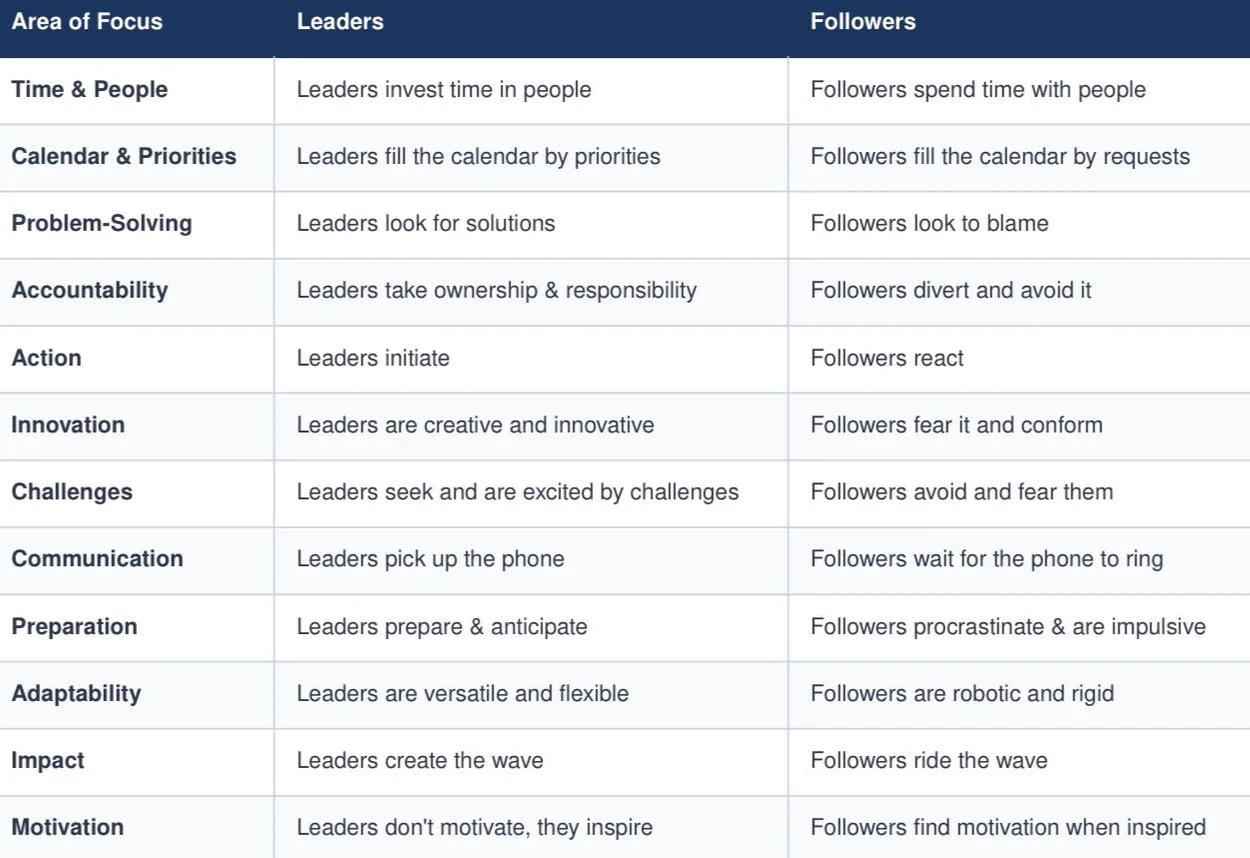
-
Follow-Through Leaders actually DO what they say they are going to do—they never let talk replace action. If something can be done in the moment, do it right then and there. If it cannot, assign it a clear deadline, prioritize it, write it down, and keep a journal or task manager.
Reframe your mental task list: it is not a "To-Do List," it is a "Get-To-Do List" because it is a privilege to “GET” to do what we do! This changes the whole perspective! It is an opportunity to make an impact, so instead of dreading a "To-Do List," we are now excited that we have a "Get-To-Do List"! Always follow up to ensure full completion and closure. In today's culture dominated by social media and superficial chatter, people spend immense energy broadcasting what they plan to do while hiding their real struggles. Silence is a sign of confidence and strength, because true leaders are busy executing rather than talking. Talk depletes energy; talking and doing fight each other.
-
Consistency Be unshakeable in what is important to you: your core principles, values, standards, the 4 Rs, and the 3 Ps. Maintain a consistent leadership style. Be yourself—do not try to be someone you are not. Keep your focus on professionalism and the primary mission at hand, and everything else will fall into place.
Strive for total balance across your mental, physical, emotional, and spiritual well-being, maintaining equilibrium between your work life and personal life. When it comes to mentorship, learn from multiple leaders without trying to clone any single person. No one is perfect. Extract the best qualities from each mentor you respect and shape those traits into your own unique leadership identity.
-
Humility: Check Your Ego Your ego is your greatest enemy. Remain a permanent student of your craft. Someone who believes they already know everything is entirely incapable of learning. The ability to evaluate yourself objectively is the single most critical skill for growth; without it, self-improvement is impossible. Arrogance and self-absorption completely inhibit leadership development.
To combat ego, practice total mental detachment using the Six-Inch Rule: step away from yourself mentally by at least six inches and objectively observe how you are acting and speaking, as if you were looking at another person.
Raw talent, skill, hard work, and confidence are not rare—what is rare is humility, diligence, and self-awareness.
Conclusion
Although we want and think big things, we must act and live small to accomplish what we seek and avoid creating unnecessary enemies. Do the little things that matter because everything counts! Aggression, intensity, self-absorption, and self-promotion only jeopardize your own efforts. If we keep our ego in check on our journey to success, when we achieve it, it will not sink us. Instead, it will make us stronger, and our success will be everlasting, respected, and valued.